
Twin4Pharma
Advancing Digital
and Green
Pharmaceutical Development
Success Story 2026
Two antibiotics in one inhalable crystal: a machine-learning shortcut to better tuberculosis therapy
Tuberculosis remains one of the world’s deadliest infectious diseases, and its treatment is hard on patients: the standard therapy means taking several antibiotics for months, which brings a heavy pill burden, side effects, poor adherence and a growing risk of antibiotic resistance. Within Twin4Pharma, RCPE has developed a digital tool that points towards a more patient-friendly answer, and it does so by predicting, rather than laboriously screening, the right materials.
Two drugs in one particle, delivered to the lungs
The idea is to combine two antibiotics into a single pharmaceutical cocrystal, a well-defined crystalline material built from two active ingredients (or an active ingredient with a suitable co-former), and to deliver it as an inhalable powder directly to the lungs, the primary site of infection. Packing two drugs into one particle simplifies the dosing regimen and cuts the number of tablets, while improving properties such as solubility and stability without changing how the drugs act. Delivered by inhalation, such a formulation can raise local drug concentrations, lower the dose required, and thereby reduce side effects and the pressure that drives resistance.
From slow screening to a predictive tool
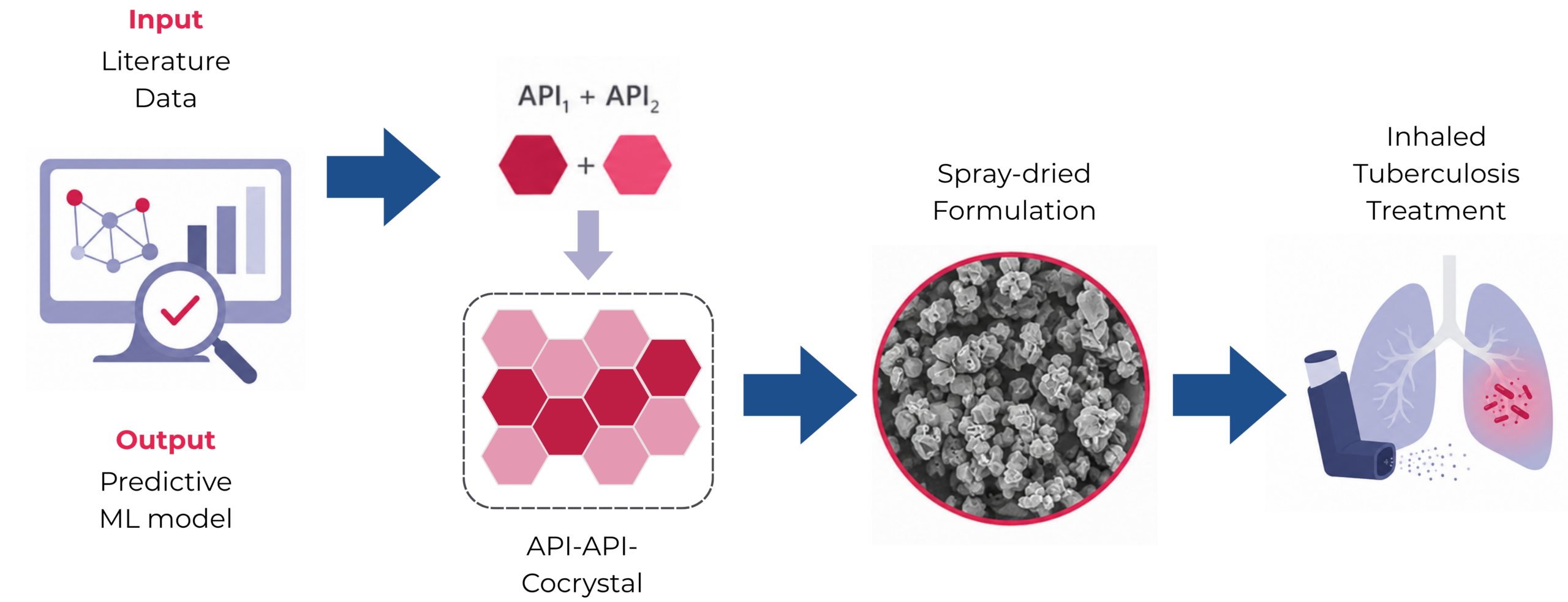
The hard part of cocrystal design is choosing which pairs will actually co-crystallise, and traditional experimental screening is slow and consumes a great deal of time and material. In a joint effort across Subprojects C3 and D, RCPE built a machine-learning model that predicts API-API cocrystal formation from molecular descriptors, trained on cocrystal data gathered from the scientific literature with the corresponding molecular structures (SMILES) retrieved from the PubChem database using an in-house extraction tool. The model is available as an application in the shared Twin4Pharma workspace, so colleagues across the module can use it without rebuilding the underlying pipeline.
First results
On literature data the model reaches a cross-validated accuracy of more than 85 %. It was then put to a prospective test on new, previously untested combinations relevant to tuberculosis: it correctly identified 10 of 16 predicted cocrystals and all 7 predicted non-cocrystals, a strong result for a first experimental campaign. The work was presented in a talk in March 2026 and in an article in the magazine Botenstoff in 2026. One predicted cocrystal formulation of Isoniazid and Levofloxacin was taken further, formulated into a dry powder for inhalation via spray-drying and tested for their aerodynamic behavior.
Why it matters
The impact is twofold. Scientifically and economically, the tool turns a slow, trial-and-error search into a fast, model-guided shortlist, which means fewer experiments, less material and lower cost on the way to a candidate formulation; for patients, the goal is a simpler, inhaled tuberculosis therapy with fewer pills, fewer side effects and less opportunity for resistance to develop. The story also shows the module working as intended: a data-driven method from the digital platform in Subproject D feeds directly into the experimental formulation work in Subproject C3, with prediction, literature mining and experimental validation connected in a single workflow. A joint publication with the crystallisation team is in preparation.
Contact

Dr. Gert Breitfuss