
Twin4Pharma
New Approaches
to
Treating
Tuberculosis
Success Story 2026
Two antibiotics in one inhalable crystal: a machine-learning shortcut to better tuberculosis therapy
Tuberculosis (TB) remains one of the world’s deadliest infectious diseases, and its treatment is hard on patients. Standard therapy requires patients to take several antibiotics for months. This creates a heavy pill burden, can cause side effects and poor adherence, increasing the risk of antibiotic resistance. Within Twin4Pharma, the Research Center Pharmaceutical Engineering (RCPE) has developed a digital tool that could help create a more patient-friendly treatment. Instead of relying on time-consuming experimental screening, the tool predicts which combinations of drug molecules are most likely to form co-crystals.
Two drugs in one particle, delivered to the lungs
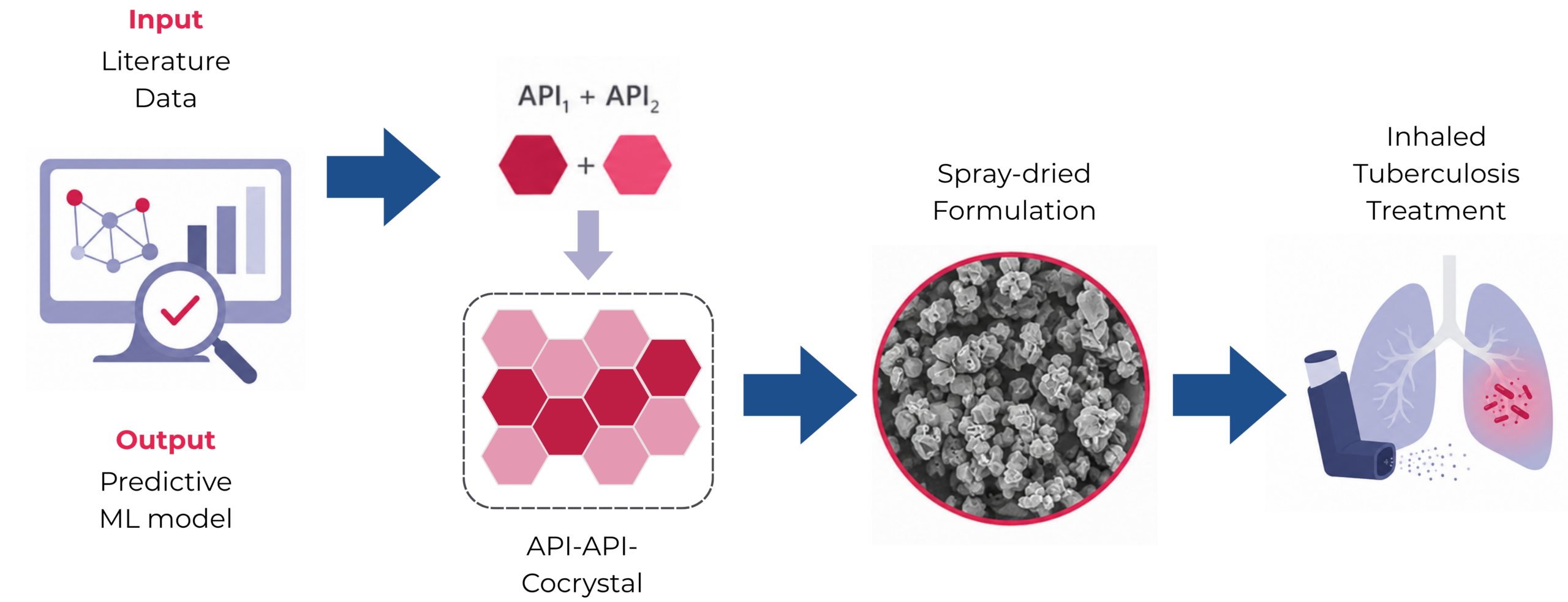
The idea is to combine two antibiotics into a single pharmaceutical co-crystal and deliver it as a powder that patients can inhale directly into the lungs – the primary site of tuberculosis infection. A pharmaceutical co-crystal is a precisely structured crystal made from two active ingredients or from an active ingredient and another compatible molecule, known as a co-former. Packing two drugs into one particle simplifies therapy and reduces the number of tablets patients need to take. Co-crystals can also improve properties such as solubility and stability without changing how the drugs act. Delivering drugs by inhalation could achieve higher concentrations at the site of infection while potentially reducing the overall dose. This may help limit side effects and the conditions that promote antibiotic resistances.
From slow screening to a predictive tool
The hard part of co-crystal design is identifying which pairs will actually co-crystallize. Traditional experimental screening is slow and requires considerable time and material. In a joint effort RCPE built a machine-learning (ML) model that predicts whether two active pharmaceutical ingredients (APIs) are likely to form co-crystals based on descriptors of their molecular properties. The model was trained on co-crystal data gathered from scientific literature. RCPE’s in-house extraction tool retrieved the corresponding molecular structures (SMILES) from the PubChem database. The model is available as an application in the shared Twin4Pharma workspace, so all Twin4Pharma researchers can use it without having to rebuild the underlying data-processing pipeline.
First results
Using literature data, the model achieved a cross-validated accuracy of more than 85. The tool was subsequently applied to identify promising co-crystal candidates for TB treatment. From a range of TB drugs , one predicted co-crystal formulation of Isoniazid and Levofloxacin was selected for further development. The formulation was converted into a dry powder for inhalation by spray-drying and evaluated for its aerodynamic behavior. This provides an initial proof of concept that digital prediction can be translated into an experimentally relevant inhalation formulation.
The work has been presented in a talk and featured in the magazine Botenstoff. A joint scientific publication is currently in preparation.
Why it matters
The potential impact is twofold. For researchers and pharmaceutical developers, the tool turns a slow, trial-and-error search into a fast, model-guided shortlist of promising drug combinations. This could reduce the number of experiments, the amount of material used and the cost of identifying a candidate formulation. For patients, the goal is a simpler, inhaled tuberculosis therapy with fewer pills and fewer side effects – and less opportunity for antibiotic resistance to develop.
The project also demonstrates how Twin4Pahrma connects digital methods with laboratory development: A data-driven method from the digital platform feeds directly into the experimental formulation work, bringing prediction, literature mining, and experimental validation together in a single workflow.
Contact

Dr. Gert Breitfuss